How To Make A Fire Without Smoke
Some say, there are three ways to recognize a spy. One of them: they know how to make a fire without smoke. Tobias Zielony’s new video work How to Make a Fire Without Smoke takes a closer look at the border between Lithuania and Belarus — in total darkness, through the lens of his camera. The border, as an abstract invisible construct (impossible to recognize by human eyes within the landscape) does remain a physical obstacle, especially for those who try to cross it. It creates an atmosphere of fear, implemented by the heavy militarization on the borders, and the pushback of refugees in the exclusion zone. The project is based on conversations with people who have experienced the border firsthand: refugees from Belarus now living in exile in Lithuania, as well as local activists.
Electricity/Afterimages
Photographs require light—and, almost always, electricity. What happens to photographic images when energy and light are limited? What space will be left for activities requiring illuminated nights? In his work Electricity/Afterimages, Tobias Zielony combines documentary images with fiction to explore a speculative future refracted through our immediate present. Since the beginning of Russia’s war on Ukraine, the neighboring country, Moldova, has experienced frequent blackouts, and energy prices have dramatically increased. In Chișinău, Moldova’s capital, streetlights are turned off at night. In conversations with his protagonists living in a world oscillating between clandestine generator-powered raves and darkened screens, Zielony’s fictional photo essay considers the relationship between the politics of energy, images, darkness, and desire
Overshoot
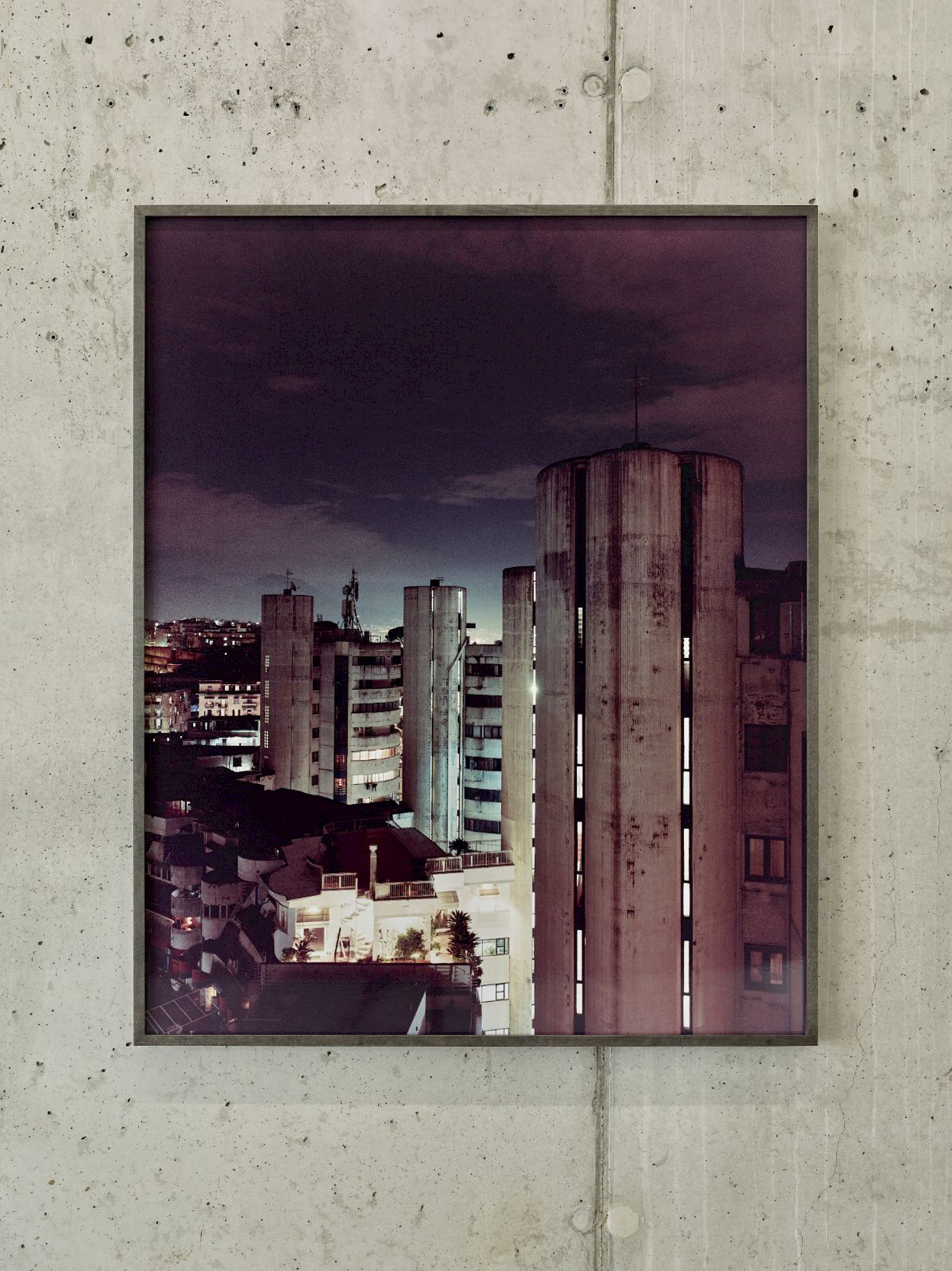
On the invitation of the Madre Museum, Tobias Zielony returned to Naples in 2024 for a project on the brutalist architecture by Aldo Loris Rossi and Donatella Mazzoleni. The term 'Overshoot’ refers to the name of a radio programme for Radio Radicale in which Aldo Loris Rossi frequently appeared. It literally means ‘going past a set point, exaggerating, spending too much, etc.’. In the last few years, the term has been used to describe the notion of excess, of going intentionally beyond what is reasonable and rational. It could also be used to describe the architectural vision of Rossi and Mazzoleni or the modus of shooting images in a continuous stream.
In Overshoot, the artist brings us face to face with some of Rossi’s and Mazzoleni’s most utopian works of architecture: the residential complex of Piazza Grande at Ponti Rossi, the Casa del Portuale (the house of the harbor workers), and the church of Santa Maria in Portici. The abundance of forms, the complex symbolism, and futuristic ideas construct a series of truly unique and phantasmal buildings. Zielony’s vision follows these structures of the buildings, the movements of the people who inhabit them, giving rise to a seemingly infinite flow of possible images and perspectives.
Photos: Ladislav Zajac



- Current
- Upcoming
- 2026
- 2025
- 2024
- 2023
- 2022
- 2021
- 2020
- 2019
- 2018
- 2017
- 2016
- 2015
- 2014
- 2013
- 2012
- 2011
- 2010
- 2009